
Table of Contents
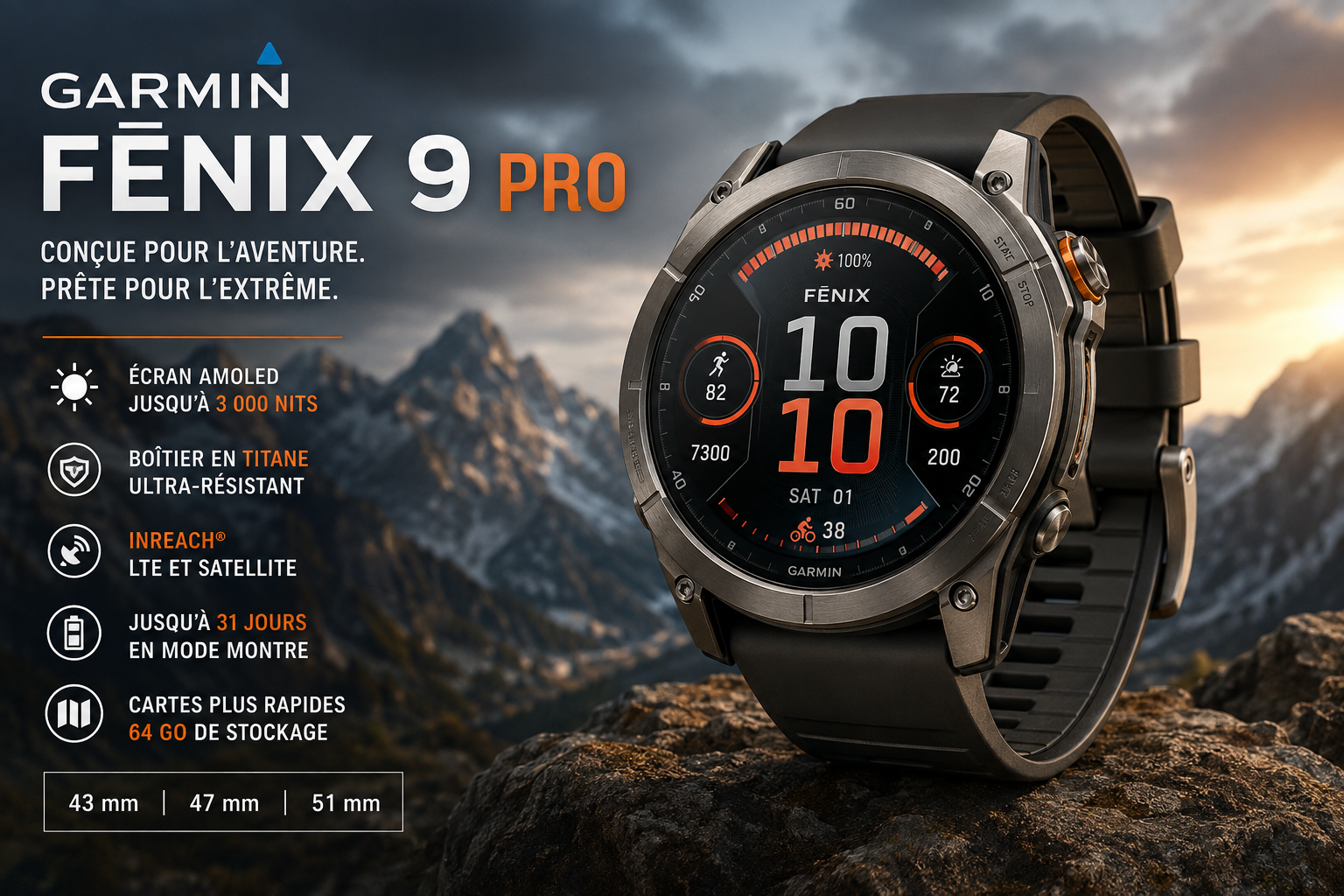
Garmin Fenix 9 Pro arrives with a full titanium case, an AMOLED display reaching up to 3,000 nits, faster mapping, and optional LTE and satellite connectivity. The premium outdoor smartwatch also brings longer battery life, Solar versions, and three case sizes for sports, travel, and serious adventures.
Garmin Officially Introduces the New Fenix 9 Pro
Garmin has officially introduced the new Fenix 9 and Fenix 9 Pro generation, with the Pro model representing the most advanced version of the company’s flagship outdoor smartwatch family. The changes go well beyond software. Garmin has also revised the construction, display, mapping performance, storage, and connectivity options.
The Fenix 9 Pro is designed for people who want one device for running, cycling, hiking, navigation, training, outdoor expeditions, and everyday health tracking. At the same time, the new materials and brighter display give it a more premium appearance for daily use.
One of the biggest changes is the move toward a titanium case. Garmin is positioning the Pro model as its most premium Fenix yet, while selected versions also add inReach connectivity through LTE and satellite.
What Is the Garmin Fenix 9 Pro?
The Garmin Fenix 9 Pro is a premium multisport GPS smartwatch built for demanding outdoor use.
It sits above the standard Fenix 9 and is available in three case sizes:
- 43 mm
- 47 mm
- 51 mm
Depending on the configuration, buyers can choose AMOLED or Solar-oriented models, while selected Pro versions also support inReach connectivity.
This approach allows Garmin to serve different types of users. Someone who wants maximum display clarity can choose AMOLED. Someone preparing for multi-day expeditions may prefer a Solar version focused on battery life.
A Full Titanium Case Changes the Fenix 9 Pro
One of the most important upgrades is the construction.
Garmin has placed a major focus on titanium, giving the Fenix 9 Pro a more premium and durable feel than previous generations that relied more heavily on reinforced polymer structures.
Titanium makes sense for an outdoor watch. It offers high strength while remaining relatively light, which is especially useful for a device worn throughout the day.
Small differences in weight and comfort can become noticeable during long hikes, endurance races, sleep tracking, or multi-day outdoor activities.
The premium material also makes the Fenix 9 Pro easier to wear outside the sports environment. It looks less like a purely rugged training tool and more like a premium everyday smartwatch.
The AMOLED Display Reaches Up to 3,000 Nits
Another major improvement is the display.
Garmin says Fenix 9 Pro AMOLED models can reach brightness levels of up to 3,000 nits.
That figure matters more on an outdoor watch than it does on many other devices.
Bright sunlight can make a smartwatch difficult to read. During hiking, cycling, or running, users often have only a few seconds to check navigation, pace, heart rate, or distance.
A significantly brighter screen can make those details easier to see without stopping an activity.
The 51 mm Model Gets a Larger AMOLED Display
Garmin gives the 51 mm Fenix 9 Pro special treatment.
The largest AMOLED model introduces a 1.5-inch display, making it particularly attractive for users who rely heavily on maps.
According to Garmin, the usable display area is larger while the outer case remains within the familiar 51 mm format.
A larger screen can make route details, data fields, elevation information, and navigation prompts easier to understand.
This is especially useful when using maps directly from the wrist rather than checking a phone.
Three Fenix 9 Pro Sizes Are Available
Garmin continues to offer multiple sizes because one watch does not fit every wrist.
Garmin Fenix 9 Pro 43 mm
The 43 mm model is the most compact option.
It is suitable for users who want the advanced features of the Pro series without wearing a very large watch.
This size may also be more comfortable for smaller wrists or for people who keep the device on during sleep.
Garmin Fenix 9 Pro 47 mm
The 47 mm model is likely to be the most balanced option for many users.
It provides a generous screen size and strong battery potential while remaining less bulky than the 51 mm version.
For general training, hiking, navigation, and daily wear, this size may offer the best compromise.
Garmin Fenix 9 Pro 51 mm
The 51 mm model is designed for users who prioritize battery life, screen size, and maximum outdoor usability.
It is also the version that receives the 1.5-inch AMOLED display.
However, it remains a large watch and may not be comfortable for every wrist.
AMOLED or Solar: Garmin Offers Two Different Priorities
The Fenix 9 Pro is not limited to AMOLED.
Garmin also offers Solar variants, giving buyers two very different priorities.
AMOLED focuses on appearance, contrast, brightness, and visual clarity.
Solar focuses more heavily on extending battery life.
If you use the watch every day in normal conditions, AMOLED may be the more enjoyable choice.
If you regularly spend several days away from power outlets, Solar may become more valuable.
There is no universally better option. The best choice depends on how the watch will actually be used.
Up to 31 Days of Battery Life on AMOLED
Garmin claims that the largest Fenix 9 Pro AMOLED model can reach up to 31 days of battery life in smartwatch mode.
Real-world battery life will vary.
GPS usage, Always-On Display, brightness level, music, sensors, connectivity, workout tracking, and notification frequency can all reduce runtime.
Still, long battery life remains one of the main reasons many outdoor users choose Garmin instead of more traditional smartwatches.
Charging once every few weeks can make a major difference during travel or multi-day activities.
Fenix 9 Pro Solar Can Reach Up to 57 Days
For selected Solar configurations, Garmin claims battery life of up to 57 days under its specified usage conditions.
That number should not be treated as a guarantee for every user.
Solar performance depends on light exposure, time spent outdoors, GPS usage, weather, screen settings, and other factors.
Even so, the Solar models are clearly aimed at people who value endurance more than display appearance.
For expeditions, trekking, or long-distance travel, fewer charging stops can be genuinely useful.
inReach Connectivity Comes to More Pro Models
One of the most important changes is the expansion of inReach connectivity.
Selected Fenix 9 Pro models can use LTE and satellite-based communication features.
This can be particularly valuable for hikers, trail runners, climbers, cyclists, and travelers who spend time outside normal mobile coverage.
A phone may become useless in remote terrain. A smartwatch with satellite-based communication options can provide an additional way to stay connected.
However, inReach functions require an active service plan, and availability depends on region, satellite visibility, network conditions, and the exact watch configuration.
Messaging From Your Wrist
Compatible versions can support two-way communication through Garmin’s inReach ecosystem.
That means users may be able to send or receive messages without depending entirely on their phone.
For outdoor users, this is more important than it may initially sound.
During a hike or endurance event, accessing a phone can be inconvenient. In poor weather, it can be even harder.
Having communication tools available directly on the wrist can reduce that friction.
LTE Calling Features
Selected configurations also use LTE to expand communication functions.
This may allow certain calling or connected features without carrying a phone at all times.
The Fenix 9 Pro is not designed to replace a smartphone completely.
However, for training sessions, short runs, or situations where carrying a phone is inconvenient, LTE support can be useful.
Regional support and service requirements should always be checked before purchase.
SOS Through Garmin Response
Emergency communication is another important part of the inReach experience.
With the appropriate service plan and compatible hardware, users may be able to initiate an SOS request linked to Garmin Response.
This can be especially relevant during remote activities.
However, no smartwatch should be treated as a guaranteed emergency solution.
Satellite visibility, battery level, subscription status, location, terrain, and other technical limitations can affect performance.
People entering remote environments should still carry appropriate safety equipment and plan their routes carefully.
Garmin Locate Helps Share Your Position
Garmin also introduces improved location-sharing tools.
With supported connectivity, family members or trusted contacts may be able to check a user’s location through Garmin services.
This can be useful for solo runners, cyclists, hikers, or anyone taking part in long-distance activities.
Location sharing can provide additional reassurance without forcing the athlete to stop and manually send updates.
LiveTrack Becomes More Useful
LiveTrack also benefits from stronger connectivity.
Selected contacts can follow an activity and receive updates as the user progresses.
This is particularly useful during long cycling rides, marathons, ultramarathons, hikes, or races.
Family members can see progress without constantly calling or messaging the athlete.
For endurance sports, this type of passive tracking can be more practical than frequent manual communication.
Weather Information Can Be Retrieved in Remote Areas
Satellite-connected configurations can also improve access to weather information in locations where conventional mobile data is unavailable.
That can be especially valuable in mountainous environments.
Weather conditions can change rapidly, and a forecast can affect route decisions, turnaround timing, or shelter planning.
Receiving updated information directly on the watch can help users make more informed choices.
Mapping Is Faster
Garmin has also improved internal performance.
The Fenix 9 generation receives more memory and an updated mapping engine designed to make maps feel faster and more responsive.
Garmin says map interaction can be significantly faster than on the previous generation.
That matters for users who regularly pan, zoom, and inspect routes directly on the watch.
Slow mapping can become frustrating when standing at a trail intersection or trying to choose the correct path quickly.
Improved Map Perspective
Garmin has also refined how maps are displayed.
The new perspective is designed to show both nearby route information and more of what lies ahead.
That is useful because smartwatch screens are small.
A good mapping interface has to provide enough detail without overwhelming the user.
Improved visual hierarchy can make navigation easier, especially when moving.
64 GB of Storage for Maps and Music
The Fenix 9 generation includes 64 GB of storage.
That allows users to keep more maps on the device and store a larger offline music library.
For travelers, hikers, and cyclists, additional map storage can reduce the need to constantly install and remove regions.
Offline music is also useful for users who want to train without carrying a phone.
A single watch can handle navigation, workout tracking, music, and communication.
New Stamina Tools
Garmin continues expanding its endurance-focused features.
The Fenix 9 Pro introduces improved stamina-related metrics, including tools designed to show how an athlete’s available effort changes over time.
These insights may help users manage pacing more effectively.
Starting too aggressively can ruin a long race.
Real-time endurance information can provide another reference point when deciding whether to push harder or conserve energy.
Garmin Epic Groups Long Adventures Together
Another interesting new feature is Garmin Epic.
It allows users to combine multiple activities into a larger multi-day or long-term adventure inside Garmin Connect.
Instead of viewing every activity as a separate workout, users can build a broader story around a trip, expedition, training block, or challenge.
Photos and health data can be added to create a more complete record.
This can be particularly appealing for people completing long trekking routes, cycling tours, or multi-stage events.
Better Indoor Rowing Metrics
Garmin is also improving indoor rowing support.
Compatible equipment can provide additional performance metrics, including estimates and power-related data.
This shows that the Fenix 9 Pro is not only about hiking and outdoor navigation.
Garmin continues to position Fenix as a complete multisport platform that can move between outdoor adventures and indoor training.
Rucking Gets More Features
Rucking support has also been expanded.
Users can track activities involving weighted backpacks and manage weight-related information during the workout.
This is a niche feature, but it can be valuable for military-style fitness, strength endurance training, or structured walking programs.
The addition reflects Garmin’s effort to cover increasingly specialized activities.
LED Flashlight With Green Light Mode
The integrated flashlight remains one of the most practical Fenix features.
On the Fenix 9 Pro, Garmin adds a green light mode intended to help preserve night vision.
That may sound like a small detail, but it can be useful during camping, hiking, overnight races, or early morning activities.
A flashlight that is always attached to your wrist is surprisingly convenient.
It can help when checking gear, finding a path, or moving around a dark tent.
Sapphire Lens Completes the Premium Build
The premium construction is complemented by a sapphire lens.
Sapphire is popular in high-end watches because of its strong resistance to scratches.
For an outdoor device, that matters.
The watch may regularly come into contact with rocks, branches, equipment, or hard surfaces.
Titanium and sapphire do not make the Fenix 9 Pro indestructible, but they improve its ability to handle demanding everyday use.
Built for Water and Outdoor Activities
The Fenix family remains focused on serious outdoor use.
Garmin continues to include strong water resistance and features designed for aquatic activities.
Selected configurations also support diving-related use within the limits defined by Garmin.
Anyone using the watch for diving should always follow the manufacturer’s official depth ratings, safety instructions, and software guidance.
Garmin Elevate Gen 5 Heart Rate Sensor
The Fenix 9 Pro continues using Garmin’s established health and fitness sensor platform.
That includes the Elevate Gen 5 optical heart rate sensor used across several of Garmin’s premium devices.
The real value of any sensor depends on accuracy in real-world conditions.
Wrist movement, skin contact, temperature, activity type, and fit can all affect optical heart rate readings.
For the most accurate sports data, some athletes may still prefer a compatible chest strap.
Fenix 9 Pro vs Fenix 9
The difference between Fenix 9 and Fenix 9 Pro goes beyond the word “Pro.”
The standard Fenix 9 still receives many of the important generation upgrades, including improved mapping, increased storage, premium materials, and the latest software features.
The Pro line adds the more advanced construction and connectivity options.
For users who do not need satellite communication or the most premium configuration, the standard Fenix 9 may offer better value.
The Pro model makes the most sense for users who will actually use its specialized features.
Fenix 9 Pro vs Fenix 8
For existing Fenix owners, the comparison with Fenix 8 is especially important.
The move to Fenix 9 Pro brings a much brighter AMOLED display, faster mapping, more storage, updated hardware, and new connectivity options.
However, the Fenix 8 does not suddenly become outdated.
If your current watch already provides enough battery life, navigation performance, and training data, upgrading may not be necessary.
The strongest reasons to move to Fenix 9 Pro are the brighter screen, titanium-focused construction, improved mapping, more storage, and inReach options.
Who Is the Garmin Fenix 9 Pro For?
The Fenix 9 Pro is not designed for everyone.
It is aimed at users who can genuinely benefit from advanced GPS, long battery life, outdoor navigation, durable materials, and multisport tracking.
For Runners
Long-distance runners can benefit from stamina tools, navigation, battery life, training metrics, and safety functions.
For Cyclists
Cyclists may appreciate the bright screen, mapping improvements, route guidance, and longer battery life.
For Hikers
This is where the Fenix 9 Pro may make the most sense.
Maps, GPS, battery life, weather information, and inReach connectivity create a strong outdoor package.
For Everyday Users
The titanium case and AMOLED display also make the watch suitable for everyday wear.
However, users who only need notifications, step counting, and basic fitness tracking can find much cheaper alternatives.
How Much Does the Garmin Fenix 9 Pro Cost?
Garmin announced a starting price of around $1,099.99 in the United States for the Fenix 9 Pro, while the standard Fenix 9 starts lower.
Final prices depend on case size, display type, inReach support, Solar configuration, and region.
European prices may differ because of VAT, taxes, distribution, and local Garmin pricing.
Before buying, it is best to check the official Garmin store for your country.
When Is the Garmin Fenix 9 Pro Available?
Garmin introduced the new Fenix 9 family on August 25, 2026.
Availability may vary by country, size, color, and configuration.
Some models may reach retailers earlier than others.
Versions with inReach or specific premium finishes may also have different stock levels.
Is the Garmin Fenix 9 Pro Worth It?
The answer depends on what you actually need.
If you only want notifications, basic health tracking, and casual exercise monitoring, the Fenix 9 Pro is probably excessive.
If you hike, cycle, run ultramarathons, travel in remote areas, or rely heavily on GPS navigation, the value proposition becomes much stronger.
The titanium construction, 3,000-nit AMOLED display, faster maps, improved storage, long battery life, and inReach connectivity are meaningful upgrades for demanding users.
The Fenix 9 Pro is best understood as a premium outdoor instrument that also happens to work as a smartwatch.
Frequently Asked Questions
What Is the Garmin Fenix 9 Pro?
The Garmin Fenix 9 Pro is a premium multisport GPS smartwatch designed for outdoor activities, endurance sports, navigation, health tracking, and advanced training.
Does the Fenix 9 Pro Have a Titanium Case?
Yes. Titanium is one of the main design highlights of the Fenix 9 Pro and helps provide a stronger premium feel while keeping weight under control.
How Bright Is the Fenix 9 Pro Display?
Selected AMOLED versions can reach up to 3,000 nits of brightness, according to Garmin.
What Sizes Are Available?
The Fenix 9 Pro is available in 43 mm, 47 mm, and 51 mm sizes.
Is There a Fenix 9 Pro Solar?
Yes. Garmin offers Solar-oriented configurations for users who prioritize longer battery life.
Does the Fenix 9 Pro Support Satellite Connectivity?
Selected models support inReach satellite and LTE connectivity. An active service plan may be required, and availability varies by region.
Can the Fenix 9 Pro Send an SOS?
Compatible inReach models can support SOS functions through Garmin services when the required plan and conditions are available.
How Long Does the Battery Last?
Garmin advertises up to approximately 31 days for selected AMOLED configurations and up to around 57 days for some Solar models under specified conditions.
How Much Does the Fenix 9 Pro Cost?
Pricing starts at roughly $1,099.99 in the United States, depending on configuration. European pricing can differ.
Is It Worth Upgrading From the Fenix 8?
It may be worth upgrading if you want the brighter display, titanium construction, faster mapping, more storage, or inReach connectivity. Otherwise, a well-functioning Fenix 8 remains a capable smartwatch.
A New Benchmark for Garmin Outdoor Watches
The Garmin Fenix 9 Pro does not completely reinvent the Fenix formula. Instead, Garmin improves the areas that matter most to serious outdoor users.
The titanium construction, AMOLED display reaching up to 3,000 nits, larger 51 mm screen, 64 GB of storage, improved mapping, strong battery life, and optional satellite communication create a compelling package.
The price is high, and many of the advanced features will be unnecessary for casual users.
For endurance athletes, hikers, cyclists, travelers, and people who regularly spend time away from reliable mobile coverage, the Fenix 9 Pro could become one of Garmin’s most complete outdoor watches to date.
⚠️ Disclaimer and Source Hygiene
This article is provided for informational purposes and is based on publicly available Garmin product information and reputable technology reporting available at the time of publication. Specifications, prices, battery estimates, service availability, and inReach functionality may change by region, configuration, and future software updates. For safety-critical outdoor use, diving, emergency communication, or satellite connectivity, always review Garmin’s official documentation and consult qualified professionals where appropriate. A smartwatch should never replace proper safety equipment, emergency planning, or responsible outdoor preparation.
🔔 For more tutorials like this, consider subscribing to our blog.
📩 Do you have questions or suggestions? Leave a comment or contact us!
🏷️ Tags: Garmin Fenix 9 Pro, Garmin Fenix 9, Garmin smartwatch, outdoor smartwatch, titanium smartwatch, Garmin AMOLED, Garmin inReach, GPS watch, sports smartwatch, Garmin outdoor watch
📢 Hashtags: #GarminFenix9Pro, #GarminFenix9, #Garmin, #Smartwatch, #OutdoorWatch, #GarminFenix, #GPSWatch, #TitaniumWatch, #AMOLED, #inReach
Sources and References
Official Garmin Sources
The main technical information regarding the titanium construction, AMOLED brightness, battery life, mapping improvements, storage, Garmin Epic, stamina tools, and inReach connectivity comes from Garmin’s official product announcements and product pages.
Secondary Sources and Early Reviews
Technology publications including Frandroid, Forbes, and specialist sports media have also covered the launch and highlighted the brighter display, titanium construction, mapping improvements, and outdoor-focused connectivity.
Early launch coverage should be treated as preliminary. Independent long-term testing will provide a clearer picture of real-world battery life, GPS accuracy, heart rate performance, satellite connectivity, and display visibility.